The History of Macrame: From Arabic Weavers to 1970s Revival
Macrame’s boho, 1970s association is really just the most recent chapter of a craft with roughly 800 years of documented history, passing through Arab weavers, European queens, and sailors on six-month ocean voyages before it ever touched a plant hanger.
Arabic Origins and the Word Itself
Most historians trace macrame’s origin to 13th-century Arab weavers in North Africa and the Middle East, who began tying decorative knots to finish the loose fringes left over from woven textiles like towels, shawls, and veils — a practical solution that evolved into its own decorative art form. The word “macrame” is generally believed to come from the Arabic migramah, meaning ornamental fringe (some sources connect it instead to the related Turkish word makrama, meaning towel or napkin).
When the Moors — Muslim rulers and settlers of North African origin — occupied the Iberian Peninsula through the 15th century, they carried the technique into Spain. From there it spread into France and Italy, taking root particularly in Genoa and the wider Liguria region by the 15th and 16th centuries.
European Royal Courts and the Victorian Peak
Macrame entered the English royal court in the late 17th century, when Queen Mary II reportedly taught the technique to her ladies-in-waiting — an early and unusually well-documented example of a craft moving from workshop practice to aristocratic hobby. Queen Charlotte, wife of King George III, was also known to practice and display the craft at court in the following century.
The technique reached its historical peak of popularity during the Victorian era, when it became a widespread pastime across social classes in England, used to decorate tablecloths, curtains, bedspreads, and doilies. Instructional publications of the period, including Sylvia’s Book of Macrame Lace (1882), helped standardize and spread technique among home crafters.
Sailors, the 20th-Century Lull, and the 1970s Revival
Separately from its aristocratic path, macrame spread globally through European and North American sailors from the 18th through 19th centuries, who already worked extensively with rope and knots for shipboard rigging and applied the same skills to hammocks, belts, and decorative bell fringes during long voyages. Among sailors, the technique was often simply called “square knotting,” after its most commonly used knot.
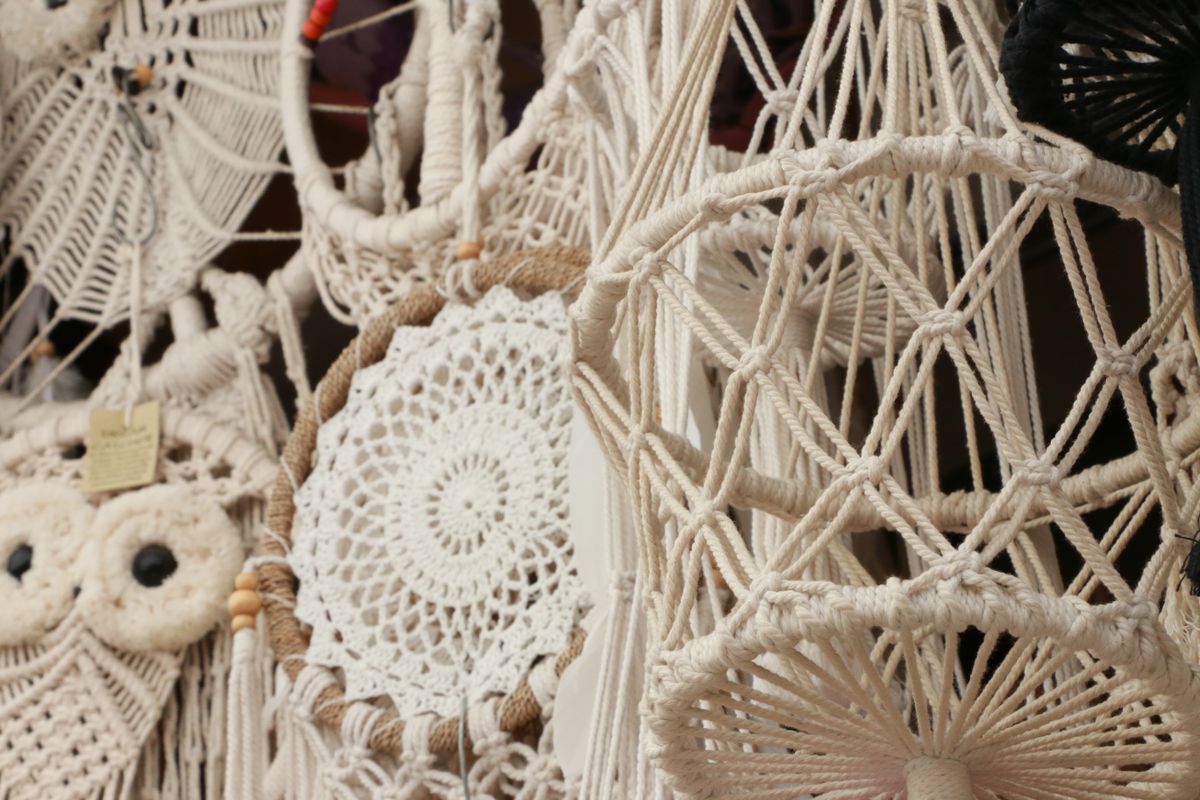
Popularity faded through the early 1900s as Art Deco and Modernist design aesthetics moved away from dense, textured ornamentation, though the craft never fully disappeared, kept alive in more folk and maritime traditions. It returned dramatically in the 1970s as a defining element of bohemian interior style — plant hangers, wall hangings, and owl-shaped decor became a fixture of the era’s living rooms — before fading again through the more minimalist decades that followed.
Frequently Asked Questions
No — the technique most historians point to as macrame’s origin comes from 13th-century Arab weavers in North Africa and the Middle East, later spreading into Europe through Moorish Spain.
Sailors already used extensive knot-tying skills for shipboard rigging, and applied the same techniques during long ocean voyages to make hammocks, belts, and decorative items, spreading the craft to ports around the world.
No — that association is specifically a product of its 1970s revival. Its earlier history includes English and French royal courts and Victorian-era home decor, both far removed from a boho aesthetic.
The rise of Art Deco and Modernist design aesthetics favored cleaner lines and less dense ornamentation, which worked against the textured, knot-heavy look of macrame, though the craft persisted in folk and maritime traditions throughout.
The Bottom Line
Macrame’s actual history spans roughly 800 years and four continents, moving through Arab weavers, Moorish Spain, English and French royal courts, sailors’ shipboard knotwork, and a Victorian-era peak in popularity — with the 1970s bohemian revival most people associate with the craft being just its most recent, and far from its only, moment in the spotlight.