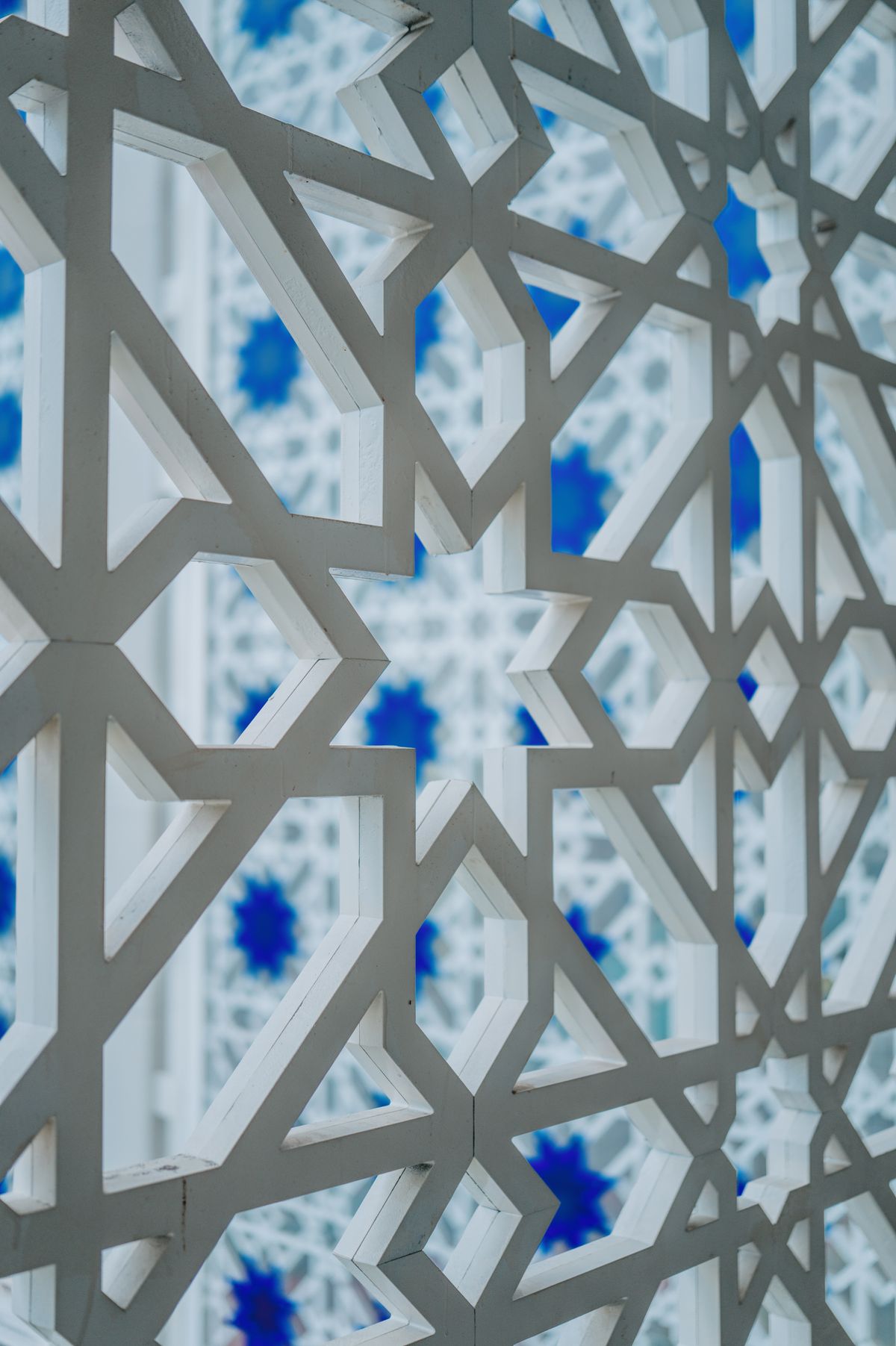
The History of Islamic Geometric Pattern and Calligraphy in Art
Islamic geometric pattern is one of the few art traditions that turns out to hold up under modern mathematical scrutiny in a genuinely surprising way. What began as religious and artistic practice a millennium ago was found in 2007 to encode a form of geometry that Western mathematicians didn’t formally discover until the 1970s.
Why Geometry and Calligraphy, Specifically
Islamic art developed its distinctive focus on geometric pattern, calligraphy, and stylized vegetal ornament (called arabesque) largely because of aniconism — a widespread avoidance, within Islamic religious tradition, of figural representation in sacred contexts. Rather than limiting artistic ambition, this constraint channeled it: geometry, calligraphy, and arabesque became the three primary disciplines of Islamic art, often described as forming a hierarchy with geometry treated as the structural foundation beneath the other two.
The tradition took shape during the Islamic Golden Age, roughly the 8th through 13th or 14th centuries, as scholars and artisans across the Arab world, Persia, and eventually Spain refined the mathematical principles behind the designs. Islamic artists didn’t invent geometric ornament from nothing — they drew on and substantially developed pre-existing geometric traditions from Greek, Roman, and Sassanian (pre-Islamic Persian) art, combining and formalizing them into something distinctly new.
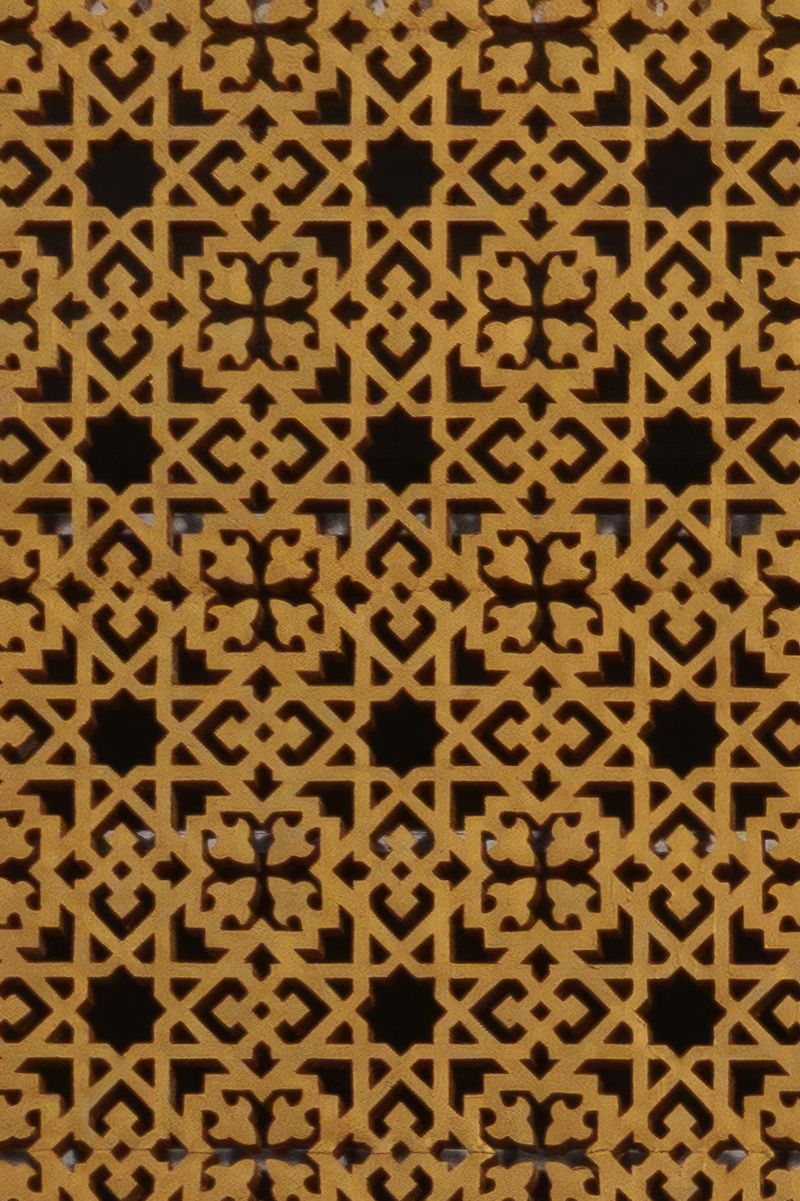
The Mathematics Behind the Patterns
The patterns are built using compass-and-straightedge construction methods, relying on tessellation (shapes that tile a plane with no gaps or overlaps), symmetry, and proportion. Four basic shapes — circles, squares, stars, and polygons — combine, interlace, and repeat to form the vastly more complex designs visible in mosques, palaces, and manuscripts across the Islamic world.
The most striking confirmation of this tradition’s mathematical depth came in 2007, when physicists Peter Lu (Harvard) and Paul Steinhardt (Princeton) published research in the journal Science showing that certain 15th-century Islamic girih tiles form patterns matching Penrose tiling — a form of non-repeating, five-fold symmetric tessellation that mathematician Roger Penrose didn’t formally describe in the West until 1973. In other words, medieval Islamic artisans were constructing a sophisticated form of geometry roughly five centuries before it was independently discovered by modern mathematics.
From the Alhambra to Modern Design
The Alhambra in Granada, Spain, built primarily during the Nasrid dynasty of the 13th and 14th centuries, remains one of the most studied examples of Islamic geometric design, particularly its integration of geometry with arabesque and calligraphy in a single unified surface. Its Court of the Lions features twelve-sided star patterns in the flooring, among the more mathematically complex designs of the era.
Techniques like zellige (hand-cut, glazed tile mosaic developed especially in Morocco) and muqarnas (three-dimensional geometric vaulting used in domes and niches) extended these principles into architecture itself, not just flat surface decoration. The influence continues today: contemporary architecture, fashion, and digital design regularly draw on Islamic geometric patterning, and the same star-and-polygon systems that decorated 13th-century mosques now appear in buildings like the Louvre Abu Dhabi.
Key Terms
- Arabesque
- Stylized, flowing vegetal (plant-based) ornament, one of the three foundational disciplines of Islamic art alongside geometry and calligraphy.
- Girih
- A system of geometric strapwork patterns, particularly associated with Persian and Central Asian Islamic architecture, that inspired the 2007 quasicrystal discovery.
- Zellige
- Hand-cut, glazed ceramic tile mosaic work, developed to a particularly refined degree in Morocco, used to create tessellated geometric wall and floor patterns.
- Muqarnas
- A three-dimensional geometric vaulting technique using tiers of small niche-like elements, used to decorate domes, squinches, and archways.
- Tessellation
- A pattern of shapes that fits together perfectly with no gaps or overlaps, theoretically extendable infinitely across a surface.
Frequently Asked Questions
It stems from aniconism — a tradition within Islam, particularly strong in religious contexts, that avoids figural representation of significant religious figures, which shifted artistic development toward geometry, calligraphy, and abstract vegetal pattern instead.
No — they built substantially on earlier Greek, Roman, and Sassanian Persian geometric traditions, developing and formalizing them into the distinctly Islamic style recognized today.
In 2007, physicists showed that certain 15th-century girih tile patterns match Penrose tiling, a form of non-repeating geometry later found to describe the atomic structure of real materials called quasicrystals, discovered in 1984.
Geometry, arabesque (vegetal ornament), and calligraphy — often described as a hierarchy with geometry as the structural foundation, frequently combined together on the same surface.
The Bottom Line
Islamic geometric pattern developed from a specific set of religious and artistic constraints into one of the most mathematically sophisticated decorative traditions in human history — sophisticated enough that a modern physics team found genuine quasicrystalline geometry encoded in 500-year-old tilework. It remains one of the clearest examples of an art form whose beauty and its underlying mathematics turned out to be the same thing.