
The Tree of Life: Symbolism and History Across Cultures
Few symbols appear as independently and as consistently across unrelated ancient cultures as the Tree of Life. Mesopotamian carvings, Norse mythology, Jewish mysticism, and Celtic tradition all developed strikingly similar tree symbolism largely without direct contact with one another — a pattern scholars describe as polygenesis, the same idea arising independently in separate places.
The Earliest Known Version: Mesopotamia
The oldest documented Tree of Life imagery appears on Mesopotamian seals dating to around 3000 BCE, and the motif was later elaborated in Assyrian palace reliefs, which depict a stylized sacred tree tended by winged supernatural attendants (often called apkallu). These carvings are generally interpreted as symbols of fertility, divine order, and royal legitimacy — the tree’s health and tending reflected the king’s connection to divine favor.
Many scholars consider this Assyrian and Babylonian tradition a likely influence on the later Tree of Life and Tree of Knowledge imagery found in Abrahamic scripture, given Mesopotamia’s geographic and chronological position relative to later Near Eastern religious texts.
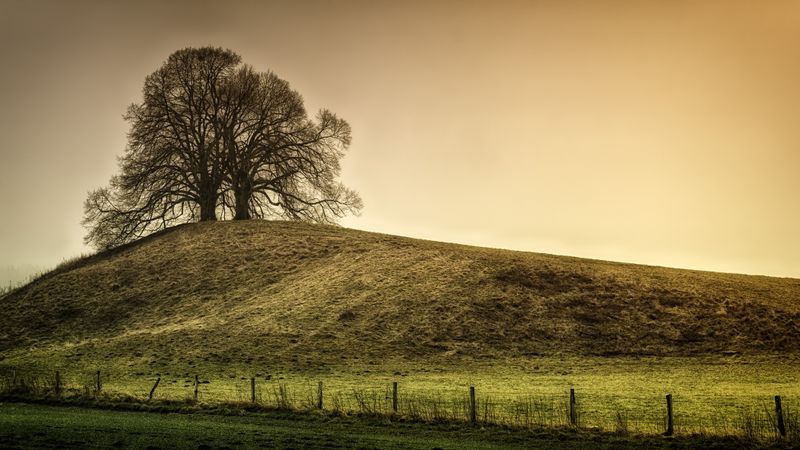
Yggdrasil: The Norse World Tree
In Norse mythology, Yggdrasil is an immense ash tree functioning as the axis mundi (cosmic axis) of the universe, connecting nine distinct worlds including Asgard (realm of the gods), Midgard (the human world), and Niflheim (a realm associated with the dead). The tree is described as under constant strain — gnawed at its roots by the dragon Níðhöggr — while simultaneously renewing itself, reflecting a Norse worldview centered on ongoing struggle and cyclical renewal rather than static perfection.
The god Odin is said to have hung himself from Yggdrasil for nine days and nights in a act of self-sacrifice to gain knowledge of the runes, linking the tree directly to themes of wisdom obtained through hardship rather than freely given.
Kabbalah, Celtic Tradition, and the Common Threads
In Jewish mysticism, the Kabbalistic Tree of Life is less a literal tree and more a symbolic diagram: ten interconnected spheres (Sephiroth) linked by 22 paths, mapping the relationship between the divine and the human soul and describing a path toward spiritual understanding. It functions as a conceptual map rather than a mythological narrative object, distinguishing it somewhat from the Mesopotamian and Norse versions.
Celtic tradition treated the Tree of Life as a symbol of harmony between humanity and nature, often rendered in circular, knotted designs representing eternity and continuous cycles of life. Despite arising in unconnected cultural and geographic contexts, the Mesopotamian, Norse, Kabbalistic, and Celtic versions of the symbol share the same core themes: a connection between the earthly and the divine, immortality or continuity, and the tree as an axis linking separate realms of existence.
Frequently Asked Questions
Mesopotamian depictions are the earliest documented, appearing on seals dating to roughly 3000 BCE and later elaborated in Assyrian palace reliefs.
No — it’s a symbolic diagram of ten interconnected spheres (Sephiroth) and 22 connecting paths, representing the structure of creation and a path toward spiritual understanding, rather than a mythological tree with a physical description.
Scholars generally attribute this to polygenesis — the same basic idea (a tree as a link between earth, sky, and underworld) arising independently in different cultures, likely because trees themselves were universally significant to early agricultural societies.
Odin, the chief Norse god, is said to have hung from Yggdrasil for nine days in a deliberate act of self-sacrifice to gain knowledge of the runes, linking the tree to the idea that wisdom requires real sacrifice rather than being freely given.
The Bottom Line
The Tree of Life is really several related but independently developed symbols rather than one continuous tradition — Mesopotamian, Norse, Kabbalistic, and Celtic versions all arose in their own cultural contexts, yet converge on the same underlying themes of cosmic connection and immortality, which is a large part of why the motif still resonates across so many different traditions today.